


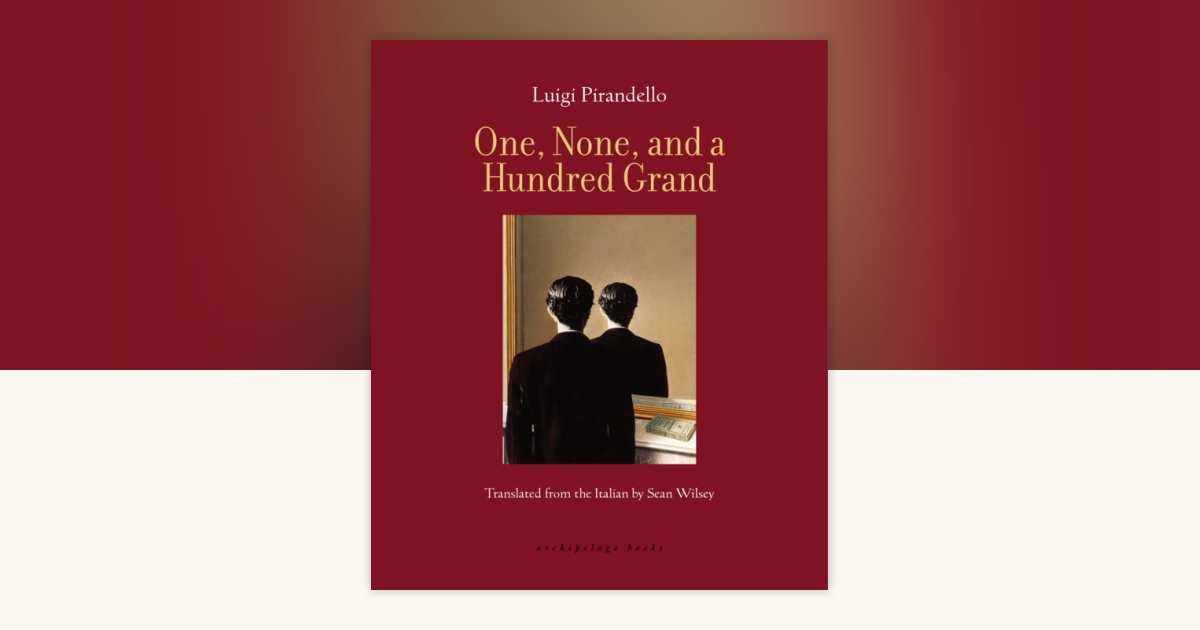
Luigi Pirandello’s last book, One, None, and a Hundred Grand, opens with a mention of a nose; a wife’s casual remark about its slight angle triggers an intense exploration of self-identity that is among the most profound in literary history. For Vitangelo Moscarda (which translates to maggot, one of several significant names in this narrative), this seemingly trivial comment disrupts an assumed completeness: if his wife perceives him differently than he perceives himself, who or what truly is he? This leads to a tragicomic disintegration of identity that, nearly one hundred years later, resonates with the energy of a contemporary fable. In Sean Wilsey’s fluid and elegant new translation, released by Archipelago Books, Pirandello’s work is rejuvenated in a time that mirrors Moscarda’s fragmented existence.
Although he is primarily recognized in the English-speaking world for his groundbreaking plays—most notably Six Characters in Search of an Author, which famously shattered the fourth wall and broke apart the illusion of stable identity on stage—Pirandello started his journey as a scholar and writer of prose. His background in linguistics and etymology informed his perspective on identity as both a product of language and a performative act. Within theater, he vividly illustrated this idea: characters rejecting their scripts, performers defying the playwright, and audiences compelled to examine their roles in constructing meaning. However, in One, None, and a Hundred Grand, Pirandello turns his focus inward, examining the multitude of fragments that comprise each individual.
“Our identities are simply obsessions,” Moscarda contemplates, reflecting the novel’s core revelation that identity is not inherent but rather an obsession. The self we show to others consists of a mishmash of compulsive self-presentations, performances, and façades; we are each one, none, and countless others—but those who observe us can only perceive a singular representation, leading us to accept that limited view. It is both tragic that we fail to perceive our true selves and ironic that we think a mirror could help us do so. The narrative embodies this predicament by transforming a middle-class banker into a philosophical jester, a mystic, and ultimately something resembling a modern-day saint, all while illustrating, through prose, the same theatrical instability that contributed to the enduring nature of Six Characters and Pirandello’s other works. In its unrelenting analysis of the self, One, None, and a Hundred Grand looks forward to concepts from Erving Goffman’s social dramaturgy to the algorithmic profiling prevalent in social media; it examines the superficial aspects of self and reveals depths underneath, finding layers that extend infinitely.
This fixation on fractured identity was more than just an intellectual pursuit. The events of Pirandello’s life—characterized by financial ruin, personal losses, and mental instability—also served as a performance of various identities. His marriage to a wife who battled paranoia and delusions left him emotionally estranged, while his own personality, seen by his acquaintances as changeable and hard to pin down, reflected the unpredictability of his characters. It is no wonder that his principal characters frequently engage in monologues directed at unseen listeners; Pirandello’s most profound conversations were consistently with himself—or, to be more precise, with the multitude of identities he recognized within.
This philosophical disorientation also, in part, stems from the author’s homeland of Sicily, an island shaped by the remnants of numerous civilizations: Phoenician, Greek, Roman, Arab, Norman, and Spanish. In Palermo, where Pirandello pursued his studies, remnants of its ethical and metaphysical legacy from the Magna Graecia endured, with Socratic irony and Heraclitean change lingering long after being absorbed into a more rigid Christian framework. This rich Mediterranean diversity pulses through the heart of the novel. “For us,” Moscarda proclaims, “the universe serves as the raw material for rebuilding. ” In the ancient South, identity was inherently more fluid, more adaptable, and more performative. The hybrid city-states of Magna Graecia promoted a conception of the self that emphasized action, dialogue, demeanor, and intonation, with the tragic chorus acting both as a glimpse into the soul and as a counterpoint to the concept of individual depth—an echoing voice that overshadowed the singularity. Raised in that environment and later educated in classical philology, Pirandello inherited an philosophy of masks and twisted it. While in Aeschylus, the mask signifies destiny, in One, None, and a Hundred Grand, destiny itself becomes the mask, though one that is perpetually put on, taken off, and recreated.
Pirandello later moved to Rome and then to Bonn, Germany, where he earned his doctorate for a thesis focused on the dialect of his hometown, Agrigento—it is significant that he had to journey so far north to explore the language of his origins. For him, language was not a clear medium but rather a nuanced veil: a landscape of distortion and diversity. Just as Pirandello’s dramatic figures challenge their creators, Moscarda disrupts the narrative flow to question his own role as the narrator. This self-referential, self-disassembling motion serves as the engine of the novel and becomes its guiding principle. In a contemporary world fixated on coherence, Pirandello champions diversity.
And this diversity is not merely psychological: it encompasses historical, economic, and spiritual dimensions. The setting of the novel reflects a time of decline and change. In the year 1903, a landslide inundated the sulfur mine that represented the wealth of Pirandello’s family—both his father’s and his wife’s. The financial repercussions were instant. His wife Antonietta, already fragile, experienced a severe mental breakdown and was never able to heal. This personal disintegration—both material and psychological—resonates throughout One, None, and a Hundred Grand. Moscarda, the heir to a local bank, intentionally undermines his own stability, systematically dismantling his riches, status, and sense of self. This is not an expression of nihilism; rather, it entails seeking clarity through obliteration.
In terms of style, the humor that Pirandello is renowned for—a mix of irony, emotional depth, and existential discomfort—is prevalent in this narrative. There is comedy in Moscarda’s ridiculous efforts at erasing himself: his exercises in front of mirrors, his public altercations, his endeavors to incite controversy merely to dissolve the perception others have of him—but this comedy carries a more somber undertone. To attain a state of “no one” does not offer a freeing escape into simple existence; instead, it requires navigating the emptiness of acknowledgment, existing without a consistent societal role. In this regard, the novel does more than portray an individual’s turmoil: it presents the moral and aesthetic dilemma of being a recognized individual. Moscarda does not enhance his self-awareness; he disperses it. He transforms into a multitude. Towards the end of the story, he begins to refer to himself in the plural form. He states, “We,” not from a place of delusions of grandeur or mental instability, but because the singular no longer seems adequate. The self, once thought to be coherent, reveals itself as a variety of reflections cast by others: the interpretation of a friend, the perspective of a wife, the view of a beggar, the opinions of a banker, and the beliefs of a priest. Pirandello foresaw the understanding that identity is never constructed by oneself alone, but is continuously shaped by the perceptions of others and the influences of place and expression.
However, Pirandello is not simply a figure of deconstruction. He also embodies, ironically, a moral viewpoint. By the conclusion of the novel, Moscarda has rid himself of all earthly goods, reputational ties, and societal identities. While he is not like Diogenes the Cynic, who lived in a barrel in Athens, Moscarda reflects a similar spirit. He does not pursue authenticity through acting, but discovers tranquility through relinquishment and denial. In this respect, his path aligns with Pirandello’s later interest in Franciscan mysticism—particularly the concept of spogliamento, or profound renunciation. Just as Saint Francis bared himself in the town square to reject his father’s riches, Moscarda liquidates his bank, donates his assets, and retreats into a hospice-like institution on the outskirts of the city. He attains, according to Pirandello’s philosophy, a form of negative sanctity—not through becoming something, but by ceasing to be anything.
Similar to Beckett’s Malone or the heteronyms of Pessoa, Moscarda realizes that how we perceive things is misleading: the observer hides what is observed. In the concluding moment of the story, he finds himself alone and unknown in the countryside, watching a donkey from a distance as it shifts and scrapes itself—just a simple animal in a detached environment. This is not a solution, but rather a yielding. It may be a fleeting grace, wherein the world ceases to reflect any specific role back to him. He observes yet remains unnoticed. He has no identity—and ultimately, that is sufficient.
Sean Wilsey’s translation artfully captures this nuanced tone with grace and humor, bringing Moscarda’s frantic inner thoughts to life with a clarity that preserves the philosophical intensity of the text. The humor of Pirandello, which is ironic yet not malicious, shines through; the narrator is both foolish and insightful, self-centered and innocent, sorrowful and oddly fortunate. Wilsey’s choice to translate the Italian title Uno, Nessuno e Centomila as One, None, and a Hundred Grand might seem slightly pretentious, but it is effective; “grand” implies not just quantity but also performance and wealth—identity as a spectacle, exaggeration, absurdity.
Six Characters in Search of an Author shattered the boundaries of the stage, while One, None, and a Hundred Grand breaks through the illusion of self-perception. This novel eerily resembles a prophetic vision for a time filled with avatars, curated personas, deepfakes, and self-observation—all of which were already latent in Pirandello’s Palermo. He provides a framework for understanding contemporary identity—a means to express the experience of existing in multiplicity, without a firm foundation. In today’s world, where identity is increasingly exploited and commercialized, Pirandello’s insistence on the absence of a fixed self becomes not only disconcerting but also liberating. We are not bound to how others perceive us, nor must we obsessively seek to define ourselves through societal acceptance. We can, as Moscarda ultimately chooses, disconnect, let go, and redefine ourselves. In essence, we can acknowledge the numerous aspects within ourselves, and thereby, catch a fleeting glimpse of true freedom.


